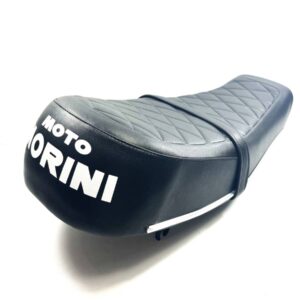
Seats

Seats, Saddles and Seat Hardware

A seat is three things that fail separately. The pan rusts from underneath where water collects, the foam either collapses or goes hard, and the cover splits along a seam long before the rest of it is finished. Which one you are dealing with decides whether this is a whole seat or a cover and a handful of fixings.

We list seat parts for British and Czech classics, from sprung single saddles through to dual seats, with the hardware that has almost always gone missing by the time a machine reaches a restoration: hinges, catches, buffers and edge trim.

Brands & Models
Brands & Models
Tags
Tags

Single saddle or dual seat?

Utility and pre-war machines generally carried a sprung saddle on a pillar, while post-war road bikes moved to a dual seat bolted or hinged to the frame loops. The mounting is what to check first. Frame tabs, loop spacing and hinge positions changed between models and between years, so a seat that looks right in a photograph frequently does not line up on the bike. Measure between your own mounting points and work from that rather than from the catalogue picture. On a hinged seat, check the condition of the frame tabs themselves while the seat is off, because they crack where the hinge has been taking the load on worn buffers.

Parts groups

  • Complete seats and saddles: where we are able to supply them
  • Covers and foam: replacement covers and the padding underneath
  • Mounting hardware: hinges, catches, brackets, rubber buffers and bolts
  • Sprung saddle parts: springs, tops and pillar components

Not sure what yours should be?

Send a photograph of the frame where the seat mounts, with the measurements on it, and tell us the model and the frame number. That settles it faster than working back through part numbers.